
Leaning Wall & Tiebacks: what it involves
A residential seawall holds back a lot of wet soil, and it does that mostly with tiebacks: steel rods or anchors that run from the cap back into the yard. Saltwater corrodes older steel tie rods, and storm surge and heavy equipment on the lawn add load. When the anchors give, the top of the wall starts to rotate out toward the water.
A lean is not the end of the wall. Many leaning walls can be pulled back or held where they are with new helical tiebacks screwed into firm soil, or with new tie rods and buried concrete deadmen. The key is getting it done while the panels are still sound, because a wall that keeps rotating will eventually crack along the cap or kick out at the toe.
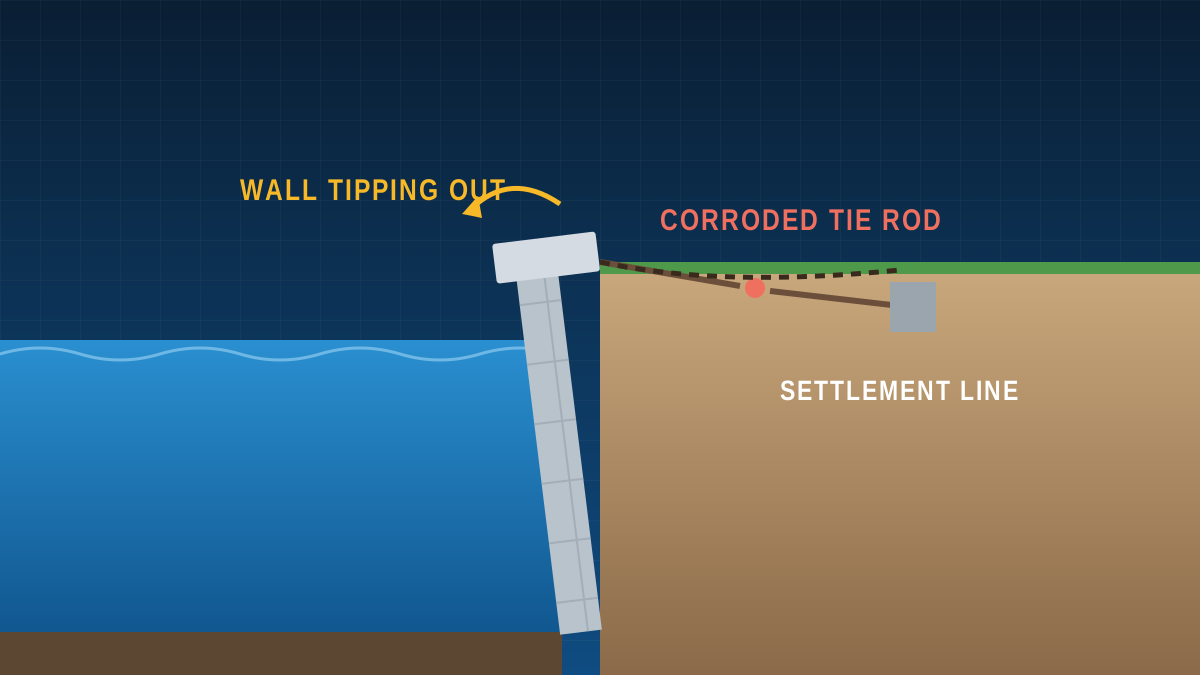
How to tell a wall is leaning
- The cap is no longer level with neighbors' caps, or a gap has opened between your cap and the next lot
- A long crack running along the cap, roughly parallel to the water
- The yard settling in a line a few feet behind the wall, where the tie rods run
- Rust staining or bulging at the cap where old tie rods attach
- Dock pilings or boat lift posts that used to be plumb now appear tilted relative to the wall
If your cap no longer lines up with the neighbors', get the lean measured now.
Free EstimateWays to stabilize a leaning wall
Helical tiebacks
Steel helical anchors are screwed through the wall or cap at an angle into competent soil, then tensioned and capped. This can be done from the yard with compact equipment.
New tie rods and deadmen
A trench is dug behind the wall, new corrosion-protected rods are installed and tied to buried concrete deadmen. It is more disruptive to the yard but works where helicals can't reach firm soil.
Toe protection
If the bottom of the wall is kicking out because the canal bottom has scoured, riprap or a new toe can be placed along the base. This usually needs its own permit review.
Permits for tieback work
Tieback and anchor work changes how the wall is supported, so expect the County's Water and Navigation section to review it, and expect engineered drawings for anything beyond a small repair. If the work also touches a dock or boat lift attached to the wall, that structure may need its own review.
- Address
- 22211 U.S. Highway 19 N., Clearwater, FL 33765
- Permits
- (727) 464-4170, WNPermitIntake@pinellas.gov
- Apply
- Pinellas County Access Portal
Source: Pinellas County Docks / Dredge & Fill, checked October 2026.
How a leaning wall & tiebacks job usually goes
- Measure the leanThe contractor records how far the cap has rotated, at several points along the wall, so later movement can be compared.
- Locate the old anchorsThey find where existing tie rods run and what condition they are in, which decides whether helicals or a trench repair fits.
- Engineering and permitFor structural work, an engineer specifies anchor spacing and load, and the permit package goes to the County.
- Install and tensionAnchors or new rods go in, are load-tested and tied to the cap, sometimes with a new cap section poured over them.
- MonitorThe contractor rechecks the measurements after a few weeks to confirm the wall has stopped moving.
Ask for the before and after measurements in writing. They are the best proof the stabilization worked, and a buyer's inspector will ask for them.
What tieback repair costs
Tieback and anchor work is structural repair, so it sits above simple crack sealing in Angi's 2026 range of about $100 to $250 per linear foot for repairs. It is still usually far below a new wall, which Florida replacement estimates put at several hundred dollars or more per foot.
Reference figure, not a quote: Angi seawall repair cost guide (2026 data), checked October 2026.
Get anchor spacing, method and price in writing from a licensed contractor.
Free EstimateAreas where leaning walls are common
- Clearwater BeachBayside walls on Clearwater Harbor that took Helene's surge
- Belleair BluffsShort Clearwater Harbor frontage with older walls
- Redington ShoresNarrow bayside lots on Boca Ciega Bay
- Indian ShoresIntracoastal frontage on a narrow barrier island
- St. Pete BeachLong Key canals and Boca Ciega Bay frontage
- Tierra VerdeCanals cut through the 1960s dredge-and-fill
- Palm HarborBayou and sound frontage on unincorporated lots
- OldsmarOld Tampa Bay frontage and canals
Related services: Seawall Crack & Joint Repair, Seawall Replacement, Seawall Inspections.
Leaning Wall & Tiebacks questions
How much lean is too much?
There's no single number. What matters is whether it's still moving and whether panels are cracking. A contractor or engineer who measures it twice, weeks apart, can tell you if it's stable.
Can a leaning wall be pushed back to straight?
Sometimes partly, sometimes not. Many repairs aim to stop the movement and hold the wall where it is, which is usually enough to protect the yard.
Will a new boat lift make my lean worse?
It can if the lift loads the wall or the soil behind it. Mention the lift during the inspection so the anchor design accounts for it.